
June 2026

On a recent visit to the Cornish coast with my son I stood for a few moments taking in the vast expanse of the bay on a hot, sunny afternoon with distant tankers shimmering in the haze and the Lizard beyond and my mind wandered to the brave men of the Royal Navy and of the Royal Air Force who protected those waters and the men of the Merchant Navy who plied them. So this month I take you back to the dark days of November 1940 when Britain, her Empire and Commonwealth stood alone against the might of Nazi Germany and to fraught and desperate engagements that cost the lives of many in order to keep these islands free.
It’s a series of incidents where the fog of war has led to claim and counter claim by historians since but I lay out the trail of historical records as I discovered them that tell the story. 959 Squadron, RAF, provided the balloon barrage for Falmouth and their Operational Record Book for Friday 29th November 1940 starts with an entry: “0351 hours – vivid flashes observed out at sea – thought to be naval action.”

The German destroyers Hans Lody, Richard Beitzen and Karl Galster had attacked and sunk the tug Aid and barge CBX 110 off St Anthony Point. The pilot vessel No 4 and Free French tug Abeille No 14 had to be towed in by trawlers after the encounter. (CBX 110 is the Admiralty War Diary designation, some sources refer to the vessel as BHC 10.)

Captain (D) 5 in Javelin, with Jackal, Jupiter, Jersey and Kashmir were ordered to patrol during the night between Start Point and Land’s End. This was the 5th Destroyer Flotilla under Captain Lord Louis Mountbatten. In response to the attack off Falmouth they sailed full steam ahead until they encountered the three enemy destroyers 20 miles SE of the Lizard crossing in front of them right to left. Mountbatten ordered an 80-degree manoeuvre to port in order to bring his flotilla onto a parallel course with the enemy ships. This change of course at full speed and on full helm threw the guns instruments out of synchronisation causing the director crews to lose their targets. The result was that Javelin was hit simultaneously fore and aft by two torpedoes and causing the after magazine to explode. Three officers and 43 ratings were killed. His contemporaries considered Mountbatten’s handling of his flotilla in this action highly controversial. He was thought by many to be a reckless, cavalier leader and had a reputation as a ‘Jonah’. However, it was that ‘daring-do’ attitude that saw him become Commander in Chief of Combined Operations later in the war overseeing some of the greatest raids and engagements of the whole conflict.

In the encounter the Navy believed they damaged one of the German destroyers, but HMS Javelin remained afloat on an even keel and was towed into Plymouth. Only 155 feet of Javelin’s original 353 feet length remained afloat. 46 of the ship’s company lost their lives. The ship was out of action for almost a year.

The Lizard lifeboat was launched in response to the smoke visible from the coast but after two hours rowing was turned back by the Navy. The gunfire could also be clearly heard along a large section of the coast. According to the Admiralty War Diary, the other destroyers swept towards Brest until 0800 but did not regain touch. At 1115 the 3 enemy destroyers were sighted off Belle Isle by aircraft. Aircraft reconnaissance of Brest saw 3 destroyers at 1230, one of which was possibly damaged.
HMS Javelin was repeatedly attacked by German bombers on her way back to port. According to the Air Ministry News Service, “The first encounter with the enemy took place off the Lizard shortly after 11am when a Spitfire pilot forming part of the Destroyers escort chased a Dornier in and out of cloud from 2500 to 6500 feet and opening fire at close range saw pieces break away from the Dornier which went into a spin and crashed into the sea. One member of the crew was seen to bale out and fall into the water.
The Intelligence Patrol Report submitted by 234 Squadron, St Eval reads: “Green Section were on patrol over Convoy 15 miles SSE of the Lizard. When Green 1 saw 3 Blenheims in line astern which seemed to be joined up by a fourth aircraft which identified as a Do. 17. The Do 17 seemed to be formatting on the Blenheims. Green 1 chased the Do 17 which was at 3000 feet going in a Southerly direction and climbing. Green 1 opened fire at 200 yards astern. He then overhauled the Do 17 in cloud and did a frontal quarter attack above cloud closing in from 100 to 30 yards. At the start of the attack he experienced return fire from front gun of Do 17 which seemed to have a limited arc of fire and was firing tracer. The enemy aircraft started falling to pieces and spun through the clouds. Green 1 followed enemy aircraft down through the clouds and saw enemy aircraft go into the sea. One of the crew was seen to bale out.” Green 1 was F/O Geoffrey Louis Ritcher, a Jewish Pilot who had joined the RAF in July 1938. He survived the war and died in 2009.
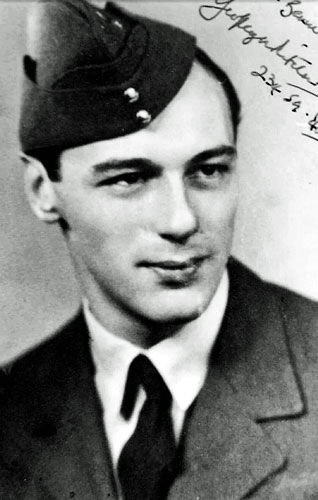
The Air Ministry News account continued: “Later in the day a Junkers 88 was intercepted by another Spitfire. The fighter pilot made three attacks in quick succession and the bomber, with its rear gun position smashed, went plunging into the sea.”
The Intelligence Patrol Report submitted by 234 Squadron reads: “Blue 1 was patrolling convoy with his section 15 to 20 miles off the Lizard when he saw Ju 88 dive out of the clouds at 3000 feet and release 4 bombs. Blue 1 gave chase getting in two bursts from astern and ending up his attack in the quarter from 180 down to 120 yards before enemy aircraft went into cloud with both engines smoking. He pursued enemy aircraft through cloud and then returned to cloud base. Here he saw Ju 88 releasing the rest of his bombs and Ju 88 climbing back into cloud. He opened fire again at 60 yards closing to 40 yards with a rear quarter attack developing into a beam attack which smashed the rear gunners cockpit and set fire to the port engine. Blue 1 searched below cloud for enemy aircraft but a thick base was encountered right down to the sea. When last seen enemy aircraft had the port engine on fire. The starboard engine was emitting dense smoke, pieces were falling from cockpit and fuselage and pilot has no doubt that it crashed into the sea.” Blue 1 was Pilot Officer Ivor Herbert Edwards who had joined the RAFVR in 1937. He survived the war. The attack was at 1435 and took place 15 miles SSE of the Lizard. Edwards fired 2040 rounds.

The Air Ministry News account continued: “A third attack, attempted by a Dornier 17, in the early afternoon was again intercepted by one of the Spitfire escorts, and the German bomber was sent down out of control.” The Spitfire was flown by Squadron Leader Blake of 234 Squadron from RAF St Eval.
Blake’s Combat Report reads: “I was patrolling the convoy as a single A/C (green 4) (Spare) and noticed a Dornier climbing at 45 degrees endeavouring to make cloud 150 yards to the left. When he saw me he turned and I came in the inside and got in a burst and stopped the port engine and he dropped a few hundred feet and made for a low cloud bank. I got two bursts at 50 yards astern into the starboard engine and then followed him into cloud which was not dense for 5 or 6 minutes getting in three more bursts and the starboard engine stopped and he flicked to the right. I tried to follow but only had 90 mph on the clock. By the time I had gained control I could not find him.” Blake filed the report claiming he’d damaged the Dornier 17. That was later upgraded to “Destroyed”. The time was 1420 hours and the place of the attack was 20 miles SE of the Lizard. It seems the Air Ministry News Service have got their order of attacks muddled up as this attack happened before Edwards.
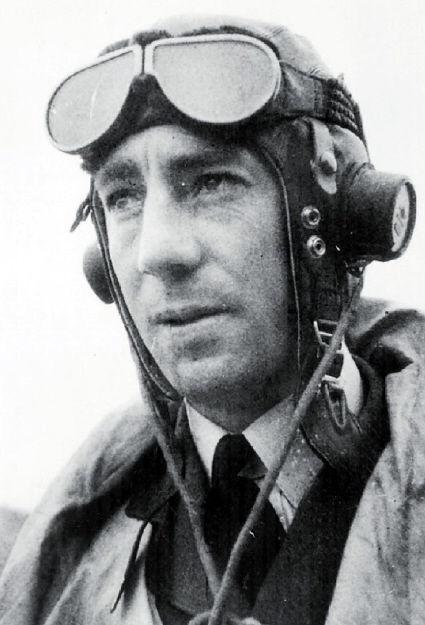
The Air Ministry News account continued: “Another German bomber, a Junkers 88, was set upon by two more Spitfires, one of which got in a burst of fire at close range. The result of this attack, which is believed to have severely damaged the bomber, could not be seen as the enemy aircraft was lost to view in the clouds.”
The Spitfire which fired was Blake’s. His Combat Report reads: “I came back at cloud base to convoy [after destroying the Dornier 17] and found a Ju 88 20-30 yards to port evidently avoiding me. I got into position to fire at him but only got a short close burst before I had to break away to avoid collision. I noticed no results.” This attack was timed at 1420 hours and took place 10 miles South of the Lizard.

The second Spitfire belonged to Pilot Officer Sgt Boddington, also of 234 Sqn. His combat report reads: “Enemy aircraft appeared from cloud – 3,500 feet – and dive bombed one destroyer. I attacked as enemy aircraft climbed to cloud, using a starboard beam/rear quarter attack. Whilst firing at enemy aircraft we both entered cloud and result of attack was inconclusive, but as burst was fired at point blank range into belly of enemy aircraft, it is believed damaged. Total rounds fired: 264.”
This is where the fog of war descends! Some experts on the Luftwaffe claim that the German records show no losses for the day and time concerned. The records of II/KG51 show their Ju88s were involved in the action. “1500 hours: attack on 3 destroyers and 1 light cruiser, four SC250 were dropped but due to enemy fighter attacks no attack results could be observed.
1520 hours: attack on a merchant ship which was sailing in a convoy with 1 cruiser and 3 destroyers, with 4 SC250 bombs; hits were observed on merchant ship.
1520 hours: two fighter attacks; attack by 7-9 Hurricanes approx 20 km S of Lizard Point.
“1525 hours: attack on a cruiser with 4 SC250 bombs. No attack results observed due to attack by fighter.
1525 hours: attack by 1 Hurricane 20km S of Lizard Point.
One Ju88 of II./KG51 returned slightly damaged by English fighters S of Lizard Point.”
As there were no Hurricanes stationed in Cornwall at this time, it seems the German aircrews aircraft recognition was not up to scratch! The account of one damaged Ju88 tallies with the British accounts. So what of the claimed kills?
The British pilots claimed a Dornier 17 crashed into the sea (with 1 crew member bale out) and a Junkers 88 (with rear gun position smashed) crashed into the sea. Their other claims were to have damaged a Dornier 17 and a Junkers 88. The Germans claim no losses and one Junkers 88 slightly damaged. Who to believe?
The British suffering under the Blitz would be glad of any German loss that would boost morale. The Air Ministry had been known to exaggerate figures during the Battle of Britain. The Luftwaffe suffering heavy losses in the Battle of Britain and increasingly so during the Blitz were known to disguise losses to prevent damaging morale.
I keep an open mind until the evidence is conclusive. I have looked for any evidence in naval records of the aerial combat but as yet found nothing. I have looked for anything relating to the German who baled out and as yet found nothing. I am grateful to Robert in Warsaw on 12oclockhigh.net for confirming the bombing attacks when other Luftwaffe experts were doubting them. Anyone with any evidence please leave a comment.

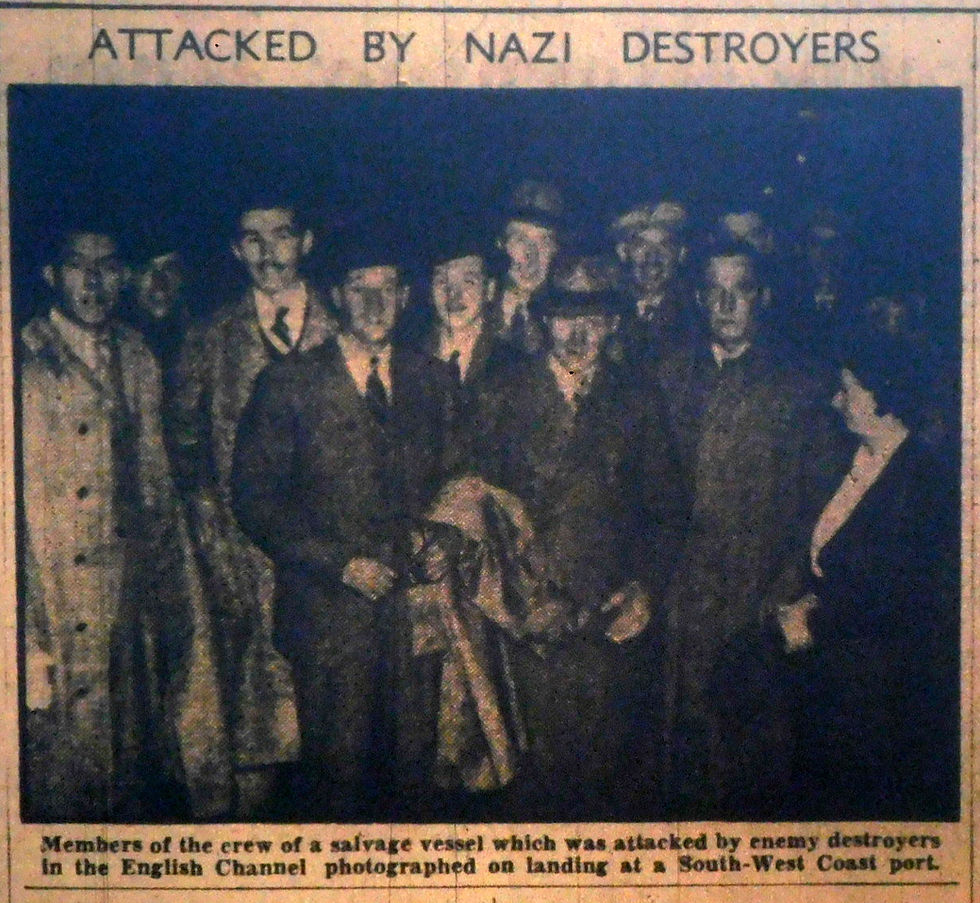
The Western Morning News on Monday 2nd December carried a photo of survivors landing at Falmouth. The website naval-history.net says that five crewmen were lost and five were rescued from the tug Aid, and three crewmen were lost and five were rescued from the barge. I can only find two burial records for Falmouth Cemetery and they say these two men were on the tug Abeille 14 – Fireman W.H. Gillet and Second Engineer Charles Grubb. The burial record shows that the two men shared a common grave, but there is only one named on the headstone – Grubb.
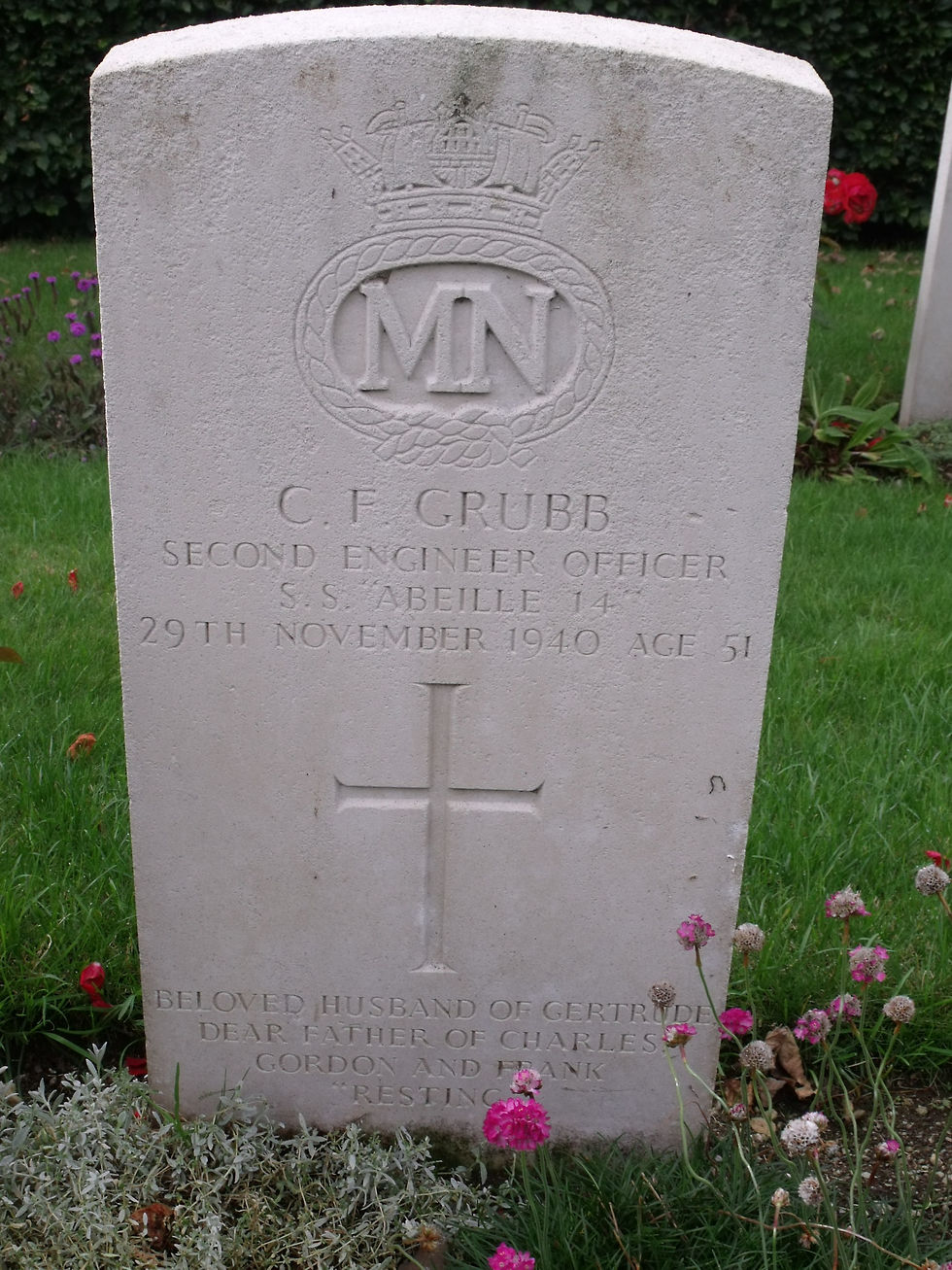
I contacted the Commonwealth War Graves Commission and Falmouth Town Council for an explanation. Falmouth Town Council simply passed the request for information to the Commonwealth War Graves Commission. The CWGC told me that Gellitt had originally been buried in Southampton (Hollybrook Cemetery) and there was no record to show he'd ever been moved. The CWGC told Falmouth Town Council that while they thought Gellitt had been buried originally in Southampton it was still possible he'd been interred in Falmouth and moved after the war before the CWGC began the process of registering the graves.
This raises all sorts of questions... Is it a simple clerical error in the Falmouth Burial Record? Is it the record of the exhumation and the permission to do so that is missing? Or was a second body buried that day in Grubb's grave? If it wasn't Gellitt, then who? And why was it covered up using Gellitt's name? This is not the only anomaly concerning the World War Two graves in Falmouth and I am in continued correspondence with both the Council & the CWGC about them but that’s a story for another time.
The casualties on that fateful night were:
HMS Javelin
https://web.archive.org/web/20170921063335/http://hms-javelin.co.uk/ Visit the site and click on ‘Roll of Honour’ to find the list of names of those who died on 29th November 1940.

Pilot Boat No 4
J Dick, A.B., Civilian
Lieutenant (E) George Percival Harding, RNVR
Ordinary Seaman John Caleb Mitchell (MiD) D/BD/X 1750
A Moore, Fireman, Civilian
Edgar Toms, Seaman, RNR
Leonard Gould Shannon, A.B., Civilian
Albert Edward Spurrier, A.B., Civilian
Temp Lieutenant Reginald Henry Whiteley, RNR

Tug Abeille No 14
William Henry Gellitt, age 25, Fireman (buried in Southampton)
Charles Frederick Grubb, age 51, Second Engineer Officer (buried in Falmouth)
Barge BHC 10
Peter Richard Walker, age 18, Cook
Ronald Edward Collins, age 17, Deck Boy
Joseph Thomas Mills, age 32, Able Seaman
Tug Aid
Samuel Edward Thacker, age 21, Cook
William Ovens, age 55, Chief Engineer Officer
Leonard Wallace Blowers, age 39, Able Seaman
William Frederick George Peek, age 25, Master
Bernard William Moyse, age 34, Second Engineer Officer
So next time you are stood gazing out to sea, pause a moment and reflect on men like these, most of whom have no known grave and are simply commemorated on the panels of the Tower Hill Memorial. They died in order that we may know freedom and peace.
Until next month, Shalom.


Comments