
April 2026

This Easter weekend the crowds that invade Sennen Cove on the Land’s End peninsula will be a mix of surfers and tourists mingling with the locals enjoying the double bank holiday weekend . As the hordes grow as summer approaches the only guys standing guard are the volunteers (male and female) of the RNLI looking to keep everyone safe in the Atlantic surf. But in the early years of World War Two the situation was somewhat different. Britain faced invasion and the Nazi planners had paid particular interest in Cornwall. Hitler in Objective 16 had singled out Cornwall for special operations before the main landing. The Germans were fully aware of the strategic role the Land’s End peninsula played in Britain’s communications with its Empire and with the United States of America. They had visited and photographed the area from 1935 to 1939 with visitors ranging from Von Ribbentrop to the sailor crews of German ships stopping at Falmouth.
While most people today are aware of the cable station at Porthcurno with its museum, underground tunnels and high profile in various TV programmes turning it over the last 10 years into a yuppie/influencer destination that sees the one road in and out of the village absolutely log-jammed with illegally parked cars, long queues, frustrated parents and squalling kids, few are aware of the cable station across the peninsula on the north coast at Sennen.
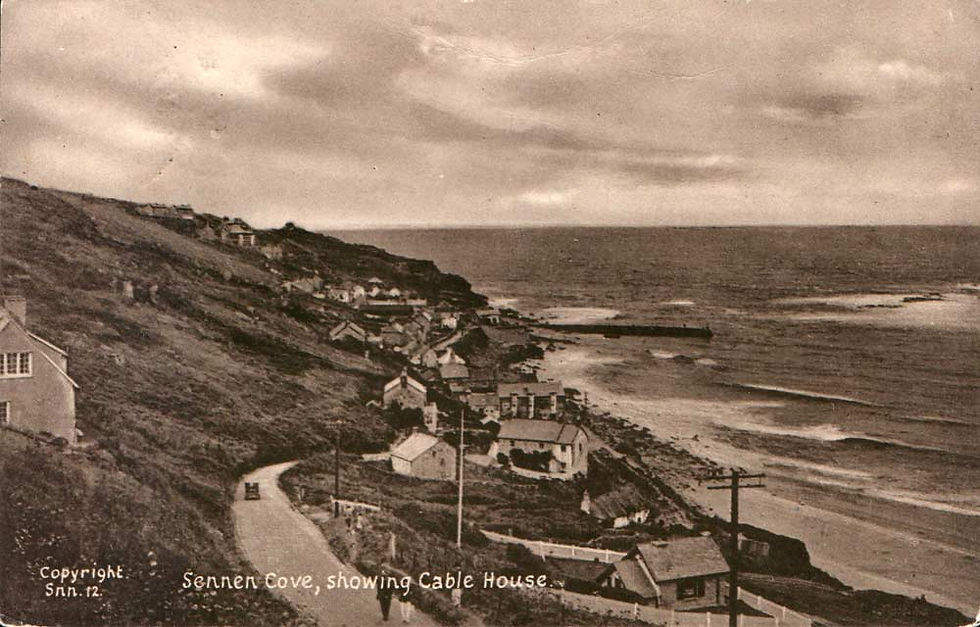
As well as the cable stations the peninsula also became home to various radar stations such as CH17 RAF Sennen, part of the Chain Home series and sometimes referred to by its local name Skewjack, CH17A RAF Mark’s Castle, a Chain Home Low radar station and also CHEL K169 Chapel Carn Brea, a Chain Home Extra Low radar station positioned on what most visitors call the first hill in Cornwall. CH17A was established by 16th October 1940, CH17 was operational by the end of 1941 although a mobile unit operated on the site from 1940, K169 became operational in 1942.
However, the main reason for defending Sennen in the summer of 1940 was the cable station. From 1881 when the Western Union laid the first two cables from Canso, Nova Scotia to Sennen (and then underground to their Cable Station in Trewithen Road in Penzance), the 1918 cable from Valentia in Ireland to the direct American line to New York which was laid in 1926, Sennen’s links across the North Atlantic were a vital part of Britain’s communication network. Sennen is clearly marked on German maps and aerial photographs from 1940 and so seizing the means of calling for reinforcements from the Empire was part of the special operations the Germans intended before Operation Sealion. Porthcurno had 14 cables connecting the UK to places such as Gibraltar, South Africa, India and Australia. Thus the British Government designated the Land’s End peninsula a Category A location – to be defended at all costs.
From the 8th July 1940 200 soldiers were earmarked for the defence of Porthcurno and a further 800 to cover Sennen and the rest of the Land’s End peninsula. Porthcurno was also to get a replica station built in two tunnels underground to protect it from aerial bombardment.

At Sennen frantic work began to build a series of pillboxes to protect the harbour and the beach. Some like the two near the lifeboat house were built close to sea level, others were built part way up the hill at various places across the back of the beach where they were able to enfilade fire across sections of the beach. Others were built at the top of the hill with some including a small rear courtyard for an anti-aircraft machine gun, usually a Lewis gun mounted on a pole. The beach in front of the Vellan Dreath valley was mined. A mix of scaffolding and coils of barbed wire stretched across the length of the golden sands. The only road out of the cove up the hill was defended by five pillboxes. An armed guard was placed at the Cable House.
One of the earliest pillboxes was brick built. The army then fired a Bren Gun at it and alarmed with the results they then added an outer layer of granite blocks to it. A little further down the hill from this experiment what is probably Sennen’s most photographed pillbox has brick walls that are 10 inches thick and an outside layer of granite that is 18 inches thick. Soldiers did what they had been trained to do, but it was a case that the locals knew best!
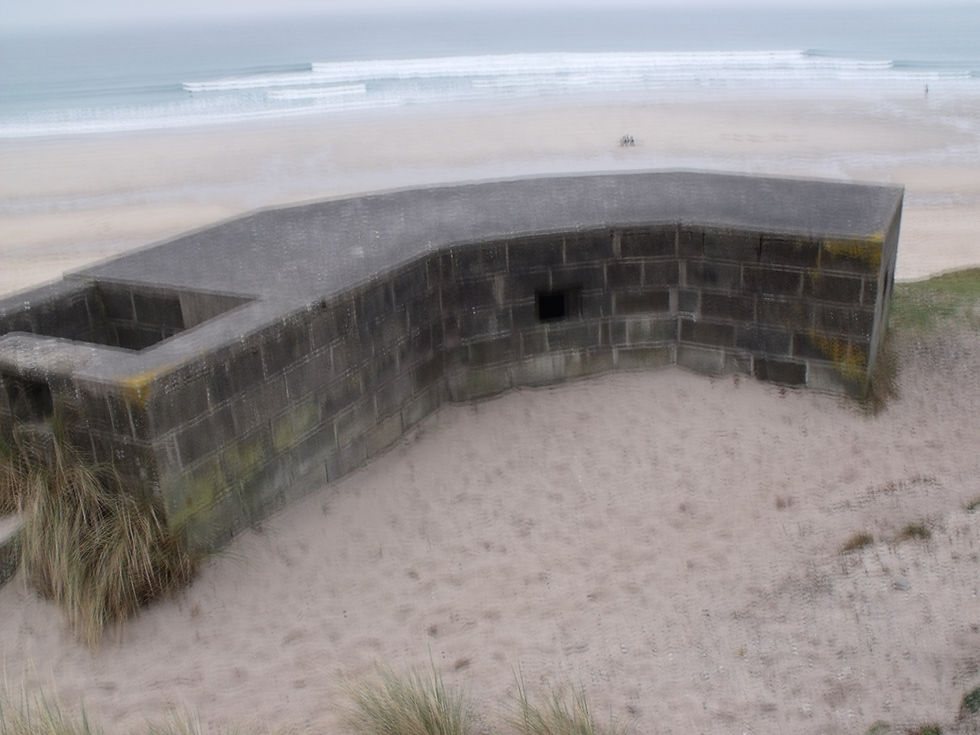
Sennen had several crescent shaped pillboxes. Several on the coastal slope are in a poor state but the one near the beach chalet by Vellan Dreath is still standing in good order. One even had an undulating roof designed to help camouflage it from the air as it looks like the granite boulders that are strewn all over the hillside.
Roadblocks were set up on the landward side such as at Treve on the A30 where a couple of the blocks remain on the verge. A more complete set can be found on the Sennen to St Buryan road where at Bosanketh six blocks can be found amidst the undergrowth. Some still have traces of the metal tubing that was used to join them.


Fortunately Sennen’s defences were never put to the test as the German invasion never came. RAF Sennen became a ROTOR station in the 1950s, the Navy had several wireless posts/signal relay stations on the Land’s End peninsula that continued their wartime work into the Cold War, and the RAF eventually left in 1970. However Sennen is still an important landing station for a number of cables. The AC-1 cable system and the Pan European Crossing (UK-Ireland) cable system both still come ashore under the sands at Sennen. ESAT 1 has a brand new Cabe Landing Station built just off the A30 at Eschalls while the Skewjack site now houses the British terminal for FLAG – Fibre Optic Around the Globe with cables coming in from the USA and from France.
For a more detailed look at the wartime defences of Sennen then check out my YouTube video Invasion at Sennen:
If you are interested in the three radar stations then these are the videos to watch:
For details on the defences at Porthcurno take a look at:
Those five should keep you busy until next month! Have a great Easter and remember that this festival marks the historical events that underpin the Christian faith – the death of Jesus Christ on our behalf and His resurrection on that first Easter Sunday confirming the success of His mission to save those who would turn to Him in faith and repentance – an invitation that is open to all of us. The Easter bunny doesn’t enter into it – unless you are not willing to face the history and wish to try and replace it. Easter is the most significant historical event this world has ever known, so check it out – it could change your life!
Until next time, shalom.


Comments