
December 2025

The World War Two generation are fast disappearing from amongst us. The vast majority of those who remain were children during the war and when I speak to them about wartime Christmases then one year in particular stands out – 1943. The reason: that was the year many of them remember being treated to a party by the American troops stationed in Cornwall prior to D-Day six months later. They have memories of food they hadn’t seen for years like real ice cream, giant Christmas trees in the Nissen huts and halls where the parties were held, being given presents, money and sweets by Santa Claus with an American accent. In a Britain of wartime shortages and rationing the kindness of the young men far from home, perhaps hoping someone back there was making Christmas special for their own children or their younger siblings, left an indelible mark in the consciousness of a generation of children who suffered the losses and deprivations of war.

So this month I thought we would visit Launceston, Cornwall’s ancient capital and gateway to the county, to discover just what Christmas was like in 1943. Many of the traditional events of an English Christmas continued, albeit in wartime guise, but as Launceston was home to the 2nd Battalion, 115th Infantry Regiment and supporting units, then many included their temporary guests.
For example, on Christmas night the Young Men’s Christian Association (YMCA) entertained both British and American troops at the YMCA Hall with proceedings led by Mrs Elaine Fitze. The evening consisted of food and games with an impromptu concert featuring a number of the soldiers and the A.T.S. girls. Also on Christmas Day the Tower Cinema was opened by manager Mr Eric H Hale for two showings at 4pm and 7pm aimed at entertaining the troops at a loose end. Both featured The Daring Young Man starring Joe E Brown, a rather silly yet funny 1942 version of the American comedy as the main billing with Private Buckeroo, another 1942 American comedy-musical which features the Andrews Sisters, as the supporting act.

Members of the armed forces could also get a cheap rate for the Dance in aid of the Red Cross Fund held at the Town Hall on Friday 17th December from 8pm until midnight. Admission was 2/6 (two shillings and sixpence – 12½ pence today) for civilians but reduced to 1/6 (7½ pence today) for those serving their country. Music was provided by the Hot Sparks Dance Band.
The Hot Sparks Dance Band were also on the billing for a Concert raising money for the Mayor’s POW Fund. By Christmas 1943 Britain had 4½ million men serving in the armed forces along with 450,000 women. 25,000 were Prisoners of War held by the Germans or the Japanese. The concert held on Tuesday 21st December at 8pm was organised by 38 year old Oswald Phelps, a dental mechanic who lived at Woodvale Terrace, Race Hill. As well as the dance band the billing also included Ena May who performed a song and a dance, Amy Dingle, a 24 year old shorthand typist, giving a recitation, Barbara Tottle who sang a carol and Mrs Ainsley who performed two solos – For You Alone and Holy City. The programme also included several sketches.
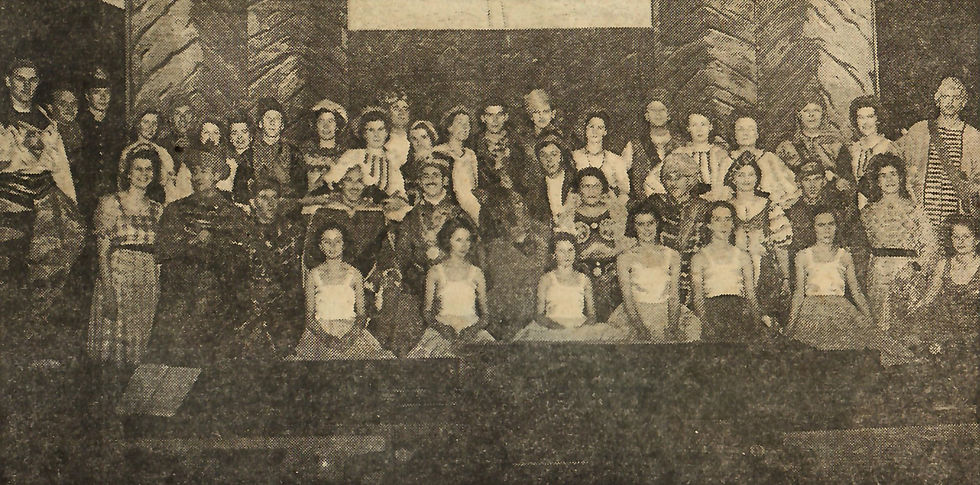
The post Christmas pantomime was Ali Baba and The Forty Thieves which ran at the Town Hall for three nights from the 13th to the 15th of January 1944. Performed by RAF personnel and Air Ministry staff it played to packed houses every night. It was produced by Flying Officer Gordon Cooper M.C. with Mr C.A. Ward as director. The profits were distributed to a range of local and national charities helping the war effort.
Thursday 23rd December saw Launceston hold a Christmas Market giving housewives the chance to purchase what poultry was available for the Christmas dinner. To help with the festive fayre the government doubled the powdered egg ration for December and wrinkled peas were free from points from December 12th. They then banned turkeys in restaurants from December 22nd in the hope more would be available for Christmas consumption.
Also on Thursday 23rd members of the RAF visited Page’s Cross Institution which until 1936 had been the workhouse. They presented each inmate with five shillings and a Christmas card bearing the RAF crest while the children received toys and sweets. Given that the Public Assistance Institute had over 90 inmates on its books in 1939 this was no small undertaking. Indeed, Master of Page’s Cross, Mr Frank H Gillard said it was the largest gift to the Institution in the last 24 years.

Life in the Institute would have been hard for its inmates but nothing compared to the sadness borne by the Pengelly family from Trebursye. On Sunday 19th December at about 7.30pm 41 year old William Arthur Pengelly, a former cowman now employed as a forestry worker, was walking from Penygillam towards their home at Trebursye with his 30 hear old wife Emma Mary Pengelly and their five year old son William Robin Pengelly when as they were passing the entrance to Tresmarrow Farm on the A30 Emma was struck by an American lorry, one of several that passed, and was knocked down. She was taken into the farm cottage and Dr Douglas Galbraith, the Medical Officer for the Emergency First Aid

Post in Launceston, was summoned. On examining the casualty he called an ambulance and Emma was taken to Launceston Hospital. A surgeon was called from Plymouth but Emma died shortly before he arrived just one hour after being admitted. At the inquest the district coroner Mr G.G. Wilson ruled that her death was due to shock following internal injuries from being accidentally knocked down by a lorry. The jury insisted on the rider that not sufficient care was exercised having regard to pedestrians on the highway. Sadly Emma was not the only casualty caused by US trucks being driven without due care and attention on Cornwall’s roads during the American presence in the county.

The day before it was a completely different scene at one of Launceston’s American camps when 400 children from Launceston’s churches were given a Christmas party that they would never forget. Children from the parish church St Mary Magdalene, the Wesley Church, the Baptist Church, the Congregational Church, the Tower Street Methodist Church, St Stephen Methodist Church, St Thomas Church, the Convent School, the Salvation Army, St Thomas Road Church and the Assembly of God were invited by Captain O.F. Schilling, a US padre. An American army band conducted by Staff Sergeant Warfield played carols and popular airs getting the youngsters to sing along. The entertainment also included a conjuror and ventriloquist who also played tunes on a baby grand piano. The children were treated to cakes and lemonade and cheered when they were served real ice cream. As they left the hut Santa gave each child a gift and a bag of sweets with sewing cases, jigsaw puzzles, balls, toys, games of all kinds and books being among the presents.

The heart of Christmas was celebrated at a Carol Service at Tower Street Methodist Church on Sunday 13th December at 7.30pm. It was chaired by Councillor Sydney Fitze, the 57 year old Ironmonger & Fruit Dealer who lived in Broad Street and was also the Commandant of the Wartime Special Constabulary in Launceston. The speaker was the Rev H.H. Griswell whilst the soloist was P/O Mason of the US Navy. A collection was taken for the POW Fund.
Thus Launceston celebrated Christmas 1943. In our world of glitz and glamour, of technology and gadgets, of tinsel and twinkling lights it speaks of simpler pleasures, of community spirit, of kindness and generosity, in the midst of war and of personal tragedy for some families. Maybe this year as the missiles and drones continue to rain down on the civilian population of Ukraine, as Jews are attacked and denounced not just on the streets of European cities, but on our own here in Britain in scenes not witnessed since the 1930s and 1940s, as a wider European war is pushed ever closer by the tyrant in Moscow and his appeaser in Washington, perhaps we need to hold our loved ones tight this Christmas and give thanks for the fragile peace and freedom we still enjoy bought at such a price by that wartime generation. Maybe we need to stop off at a carol service and again hear the message of the Babe of Bethlehem, the Prince of Peace, to give us a clear perspective on where we are at personally, nationally and internationally as we discover the heart of the problem is the problem of the heart and I firmly believe the only one who can truly change that is Jesus. That first Christmas God didn’t send an educator, He didn’t send a reformer, He didn’t send an inventor or a scientist, He didn’t send a computer programmer or a social worker – He sent a Saviour.
May I wish you and all your family and loved ones a blessed and peaceful Christmas.
Until next year, Shalom.


Comments