
February 2026

Several readers of my first novel “No Small Stir” have made the comment to me: “I can just imagine spies operating in Cornwall. It all fits the place so well.” Spies operating in Cornwall is not something I have made up. While Johann and his particular antics are creations of my imagination, there were a number of wartime spies who were arrested in Cornwall. None were particularly successful, perhaps due in part to the vigilance of people like Bob Dunstan, the MI5 operative in the port of Falmouth who had personally apprehended several, perhaps also to the natural suspicion of the Cornish towards outsiders until they get to know you and realise you’ve come to embrace them not change them.
This month I thought we’d concentrate on the south coast port of Fowey where due to the secretive nature of the work of apprehending those seeking to damage Britain and her interests the events are still under a cloud of mystery.

Let’s pick up the story in the summer of 1940. France has fallen, the BEF are home, Britain’s supply of chemical weapons (taken to France just in case the Germans repeated their Great War use of such weapons) have arrived back through the port, being landed at No 8 jetty in the docks up round the bend of the river out of sight of prying eyes. On Monday 15th July 1940 at 1525hrs 4 High Explosive Bombs were dropped on Fowey on the east side of the river. There were no casualties, not very extensive damage, just a lot of broken windows. "Q" - Sir Arthur Quiller Couch, the famous Cornish author and critic, lived at The Haven in Fowey. He also owned the Orchard Garden on the slopes below the Hall Walk. A ship was berthed just off Prime Cellars, and this was the target of the bomber. The first bomb fell just twenty feet from Sir Arthur striking the cliff and sending shale into the air as he fell flat on his face. His gardener with him, Joe Welsh, was deaf but reported hearing a noise that day! The second bomb blasted some oaks and tore down some cliff. The third made a crater amidst the trees and the fourth fell in the water.
The blast travelled across the water and broke most of the closed windows in Fowey. John Libby recalled "Fore Street covered in a carpet of glass from Trafalgar Square to Custom House Hill" as all the shop windows shattered. Evelyn Bowden was in the Gas Showroom near the Ship Hotel and remembered her Gran coming down the street with her hair flying to make sure she was okay. Charles Rockey was in lessons at Fowey Boy's School when the explosions interrupted the teacher and rattled the windows. Sir calmly said work must be going on in the harbour and suggested the boys move out of the room with so much glass. They crouched under the stairs where a Dutch refugee whose father had a small cargo boat in the harbour told Charles "Stukas over Amsterdam I saw them. Not workings on river! Bombs!" Charles Rockey walked home from school that afternoon through the town and nearly every shop window had been blown out by the blast. "Thankfully," he said, "I was to find my parents' house was safe, except for a new large crack in the ceiling of my bedroom." There were rumours in the town that the ship targeted was loaded with bullion, others said she was full of ammunition. Those variations in the story continue to the present day.

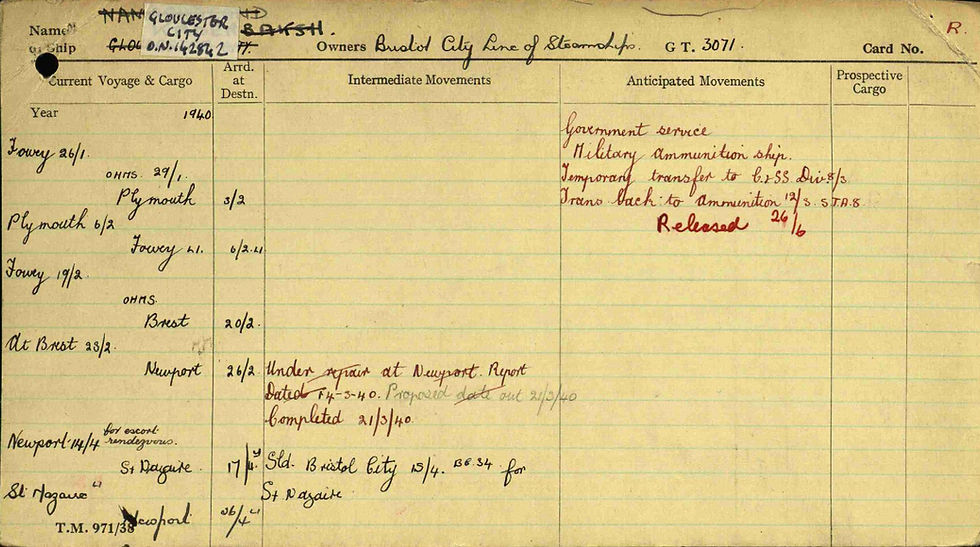
The ship was the SS Gloucester City. In January 1940 she was taken over by the government and used as an ammunition ship to take supplies to the BEF in France. Her movement card shows she plied between Fowey and ports in South Wales and various ports in France such as Brest, St Nazaire and the finally the River Loire. She left France after 2nd June for the last time and sailed back to South Wales before arriving in Falmouth on 26th June when she was released from her work as an ammunition ship. She arrived in Fowey on 13th July. The ship had arrived in the port to load with china clay. Thus she was not carrying bullion or ammunition at the time of the air raid. She left Fowey at 1800hrs on 25th July to join up with a convoy at Milford Haven. Gloucester City's cargo of china clay was bound for the USA and was unloaded at Trenton. The crossing was eventful as German U-boat ace Otto Kretschmer in U99 found the convoy west of Ireland and sank the British ships Jamaica Progress & Jersey City.

However, two unusual things had happened in Fowey while the Gloucester City was there. Firstly, its third officer, a 26 year old navigator named Zahm (some sources spell it Zahn), who had signed on the ship with two Cornish sailors at Fowey on 3rd January 1940, was arrested on suspicion of being a spy and taken to Exeter Prison. According to fellow crew member Arthur "Toby" West from 49 High Street in Falmouth (born 3 June 1919) who signed on the same time as Zahm (the other sailor being Ken Petersen of Flushing), Zahm, known to speak fluent French & German, spent a lot of time away from the ship to be with his wife more, so he said. This was reported to Lt Wing, in charge of loading the ship, who expressed his surprise as Zahm was unmarried. Captain Sydney Glyn Smith ordered a thorough anti-sabotage search made of the ship. Zahm was missing and enquiries were then made ashore.

Secondly, No 24 Lostwithiel Street, Fowey, is a white house on the hill many plod past as they make the walk back up to the car park. During the war it was a Bed & Breakfast establishment run by Mrs Florence Hawke and her 23 year old daughter Felicia. In July 1940 Felicia was cleaning the bedrooms one day and noticed a case under the bed in one of the rooms. Curious, she opened it and immediately became suspicious at the contents. She informed her father, Bill, who was a military policeman in Fowey. He quickly realised the contents of the case were a radio transmitter.
The female "guest" was arrested and linked to the missing Zahm on the SS Gloucester City. John Libby, who lived opposite the B&B during the war, says Zahm was arrested on the road to Mevagissey, Richards & Reynolds in 'Fowey At War' that he was apprehended at Torpoint. And there the trail goes cold. I have been unable to find any official record of these two spies and the outcome of the story.
Had the spies given away the location of the ship for the bombing raid on it on Monday 15th July 1940? Was Zahm aboard at the time of the raid or was he conveniently ensconced ashore? Was the sailing of the ship revealed to the enemy enabling them to track the convoy with their U-boats? Just who was this mysterious guest and what was their link to Zahm? Were they British or foreign nationals? Were they found guilty of treason, espionage, spying? If so, what was their punishment?
Between 1940 and 1946 a total of 19 spies and saboteurs were prosecuted under the Treachery Act and executed. When Churchill became Prime Minister on 10th May 1940 he was worried about Fifth Columnists operating in Britain. When he was told that any British nationals among them could be prosecuted for treason but that foreigners could not, the new Prime Minister demanded a new law immediately. By 23rd May the Treachery Act which outlawed conduct “designed or likely to give assistance to the naval, military or air operations of the enemy” had passed through both Houses of Parliament and received Royal Assent. It carried only one sentence: death. No woman was ever executed under the wartime Treachery Act and Zahm’s name is not in the list of the 17 known to have been executed. So did they receive a lesser sentence, if ever charged at all? Were they turned and became part of the Double Cross operation? Or were they left to languish in a place like Camp 020 or interred on the Isle of Man (The only Zahn I have found there was an 80 year old retired litho artist who was deemed not necessary for internment. He died in London in 1944) for the duration?
I am satisfied given the range of people (unknown to each other) who have contributed to what is known of the two incidents that we are dealing with an actual event and not a wartime rumour. All of the other people show up in official records with the exception of Zahm and the un-named guest at 24 Lostwithiel Street. I share the story in the hope that someone’s family have the information that will unlock the outcome of the incident. Any information gratefully received.
So spies along the Bodmin Stop Line in the summer of 1940 is not a far-fetched notion. In fact, it is a good basis for an exciting novel. If you’ve not yet read No Small Stir you can buy a copy from this website.
Until next month.
Shalom


Comments